
Have you ever walked into a room and wondered if you belong there? I have. More times than I can count.
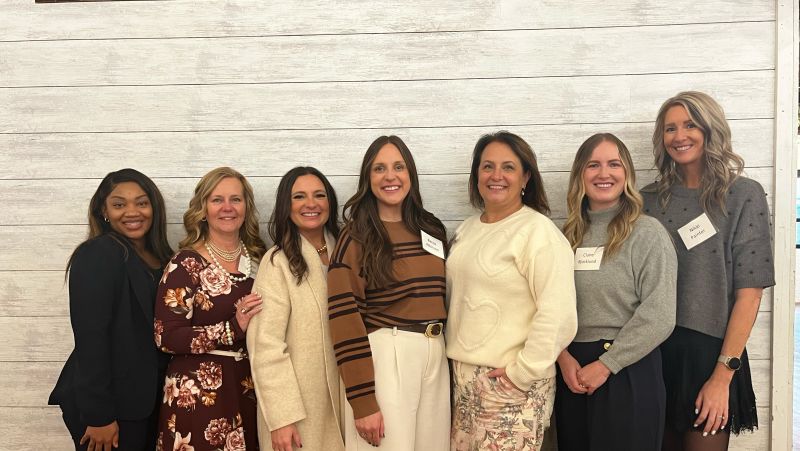
On Thursday, I walked into Harvester Square for the Women’s Fund’s 25th anniversary luncheon. About 150 women filled the room: founding mothers, board leaders, business owners, and young women just getting started, like me. I was there as a student leader, invited by my mentor, Njeri Clement.
And for once, I didn’t wonder. I felt it.
I came expecting a luncheon. I left knowing what inclusivity, belonging and friendship look like when women of every age and background build something together and then hold the door open for the women coming next.
It started with friends and Post-it notes
The Women’s Fund of the Central Minnesota Community Foundation started in 2002 from the vision of Barb Carlson and a circle of women who believed in her. From the beginning, they focused on three groups: girls, women facing adversity, and elder women.
They didn’t start with a big check. They started with each other, and a poster covered in Post-it notes. Each note stood for a pledge, someone saying “count me in.” Barb’s goal was to raise $1 million with 1,000 people.
Sonja Gidlow, one of the founding members, admitted she didn’t have a fundraising background back then. “But Barb did, thank goodness,” she said, “because she was able to break it down into manageable post it notes.”
Today the fund has given more than $2.3 million in grants, over 400 of them to more than 150 organizations, and built endowments of just over $10 million for generations to come.
Belonging: “It felt like home”
Friendship was in every story. Molly Renslow, the fund’s first chairperson, told us about the founders’ rooftop photo. When the proofs came back, the women looked like “fierce warriors.” She and Barb looked at each other and started laughing. Twenty-five years later, she still cherishes that photo.
Claudia Revermann, who is finishing her ninth and final year on the board, remembered her very first Women’s Fund meeting. It was a planning session at a member’s home, and she knew maybe one or two people there. She called herself a “fish out of water.”
Then, she said, “I felt the warmth, I felt the curiosity. People wanted to know about me.” It “felt like home immediately.”
That’s what belonging is. Not just being allowed in the room but being wanted there.
And the friendships kept passing it forward. The moderator, Willow Sweeney Flaherty, thanked Claudia as “the one that got me into this all those years ago.” Claudia introduced Njeri as “my dear friend.” Women bringing women. That’s how this whole thing grows.
Inclusivity: taking the blinders off
Claudia was honest about something a lot of organizations never say out loud. A few years ago, while she was chair, the board asked itself, “Does our board represent the people that we are serving?”
The answer was no. “We only know what our blinders or our little circle sees,” she said. So they started asking each other, “Who do you know? Who do you know that knows somebody?”
The women they reached out to had real questions. “Do I actually have a voice at the table if you do invite me? And are you just trying to fill a board seat?”
The board’s answer: “We want more experiences; we want more perspectives.” They filled those seats with different worldviews, and Claudia said it changed the way the board works. Now they pause and actually listen to each other. She called it “a phenomenal gift.”
Njeri took it even further. “Women have changed in order to survive,” she said. “But sadly, systems have not changed to support women.” She reminded us that “visibility is not representation,” and asked us to stop only telling women to be resilient. Instead, she said, let’s make systems “inclusive and adaptable and equitable so that women do not have to carry all these alone.”
One way to start, she said, is to bring underrepresented communities into the spaces where money and decisions happen, “because they know what their communities need.”
Every age at the table
Look around that room and you saw every generation: founding mothers who started this 25 years ago, the women leading it now, and young women just getting started, like me.
One panelist said it simply: “They say if you see it, you can be it.” Her hope is that girls and women can see it happening, so they can be it too.
Njeri challenged everyone to go beyond mentoring and into sponsorship, which she described as “inviting another woman into your networks.” She also shared that the Women’s Fund is talking about board opportunities for college students to serve during an academic year, so young women can see how these decisions get made. As a college student, I felt that one.
Willow brought two young women with her, both 20, whom she thinks of as nieces. Neither of them knew why they’d been invited. She told them, and all of us, that “your opinions are valued, your experience is priceless, and leadership really is just about showing up. Tell somebody you want to serve in whatever capacity and do it.”
Why St. Cloud is a hub for connection
This part made me proud of where we live.
Sonja moved here from Lake Elmo more than 30 years ago. “We are large enough to have resources,” she said, “but we are small enough to get decision makers in one room to make things happen.” Smaller towns can struggle with resources, and bigger cities can make it hard to get the right people together. Here, she said, a few calls and emails can get people in a room making decisions.
Willow said she asks her friends in the Twin Cities, “Which board are you on?” and “they look at me like I’m a crazy person because they don’t have access to this.”
That stuck with me. We sometimes think the big opportunities are only in the Cities. But here in St. Cloud, a student like me can sit in a room with founding mothers, board chairs and community leaders, and actually be heard.
What the founding mothers left behind
Every speaker came back to the same idea. The founding mothers weren’t building this for themselves. One speaker put it this way: “Somewhere in our community, there is a woman or a girl whose story can be different because of what we choose to do. We may not know her name. We may never meet her.”
Claudia named the pattern she’s watched all these years: “women rising up, women taking action, women inviting people to the table, and then not exiting, but moving over so that other women can be part of this.”
Moving over. Not leaving. Making room. That’s the legacy.
Njeri closed with something she wrote for the day. She pictured the founding mothers gathered in one of their homes, not knowing how far their idea would travel. She wondered if they ever imagined a girl from rural Africa would one day chair the Women’s Fund and help carry their vision forward.
“We rarely get to meet everyone who will find shelter under the trees we plant. … I stand on the shoulders of the founding mothers, some of whom I may never have the privilege of meeting. … Today I am one of those fruits. … When women make room for other women, the impact can travel across generations and across oceans. My hope for the next 25 years is that we become the founding mothers for someone else’s tomorrow.”
I got chills. I’m still getting them.
Why this matters to me
I’m a first-generation college student, and I’m learning what leadership looks like while I’m still figuring it all out. Sometimes I wonder if there’s really room for me in rooms like that one.
This luncheon answered that. Belonging isn’t something you wait for. It’s something women give each other, one invitation, one friendship, one open seat at a time.
The founding mothers planted the trees. Njeri is standing in their shade, and so am I, right behind her, learning. Someday I hope to plant something too.
That’s what they want to leave behind. Not just money. A table with room at it, and women who keep pulling up more chairs.
Your turn
The Women’s Fund wants its table to be open. They have committees that meet just a few times a year, and they welcome new ideas from anyone. If you’re a woman at SCTCC wondering whether there’s a place for you in rooms like this, there is. And here in St. Cloud, you’re closer to that table than you think.
Learn how to get involved at Central Minnesota Community Foundation
Sources: event remarks recorded at the Women’s Fund 25th Anniversary Luncheon.