
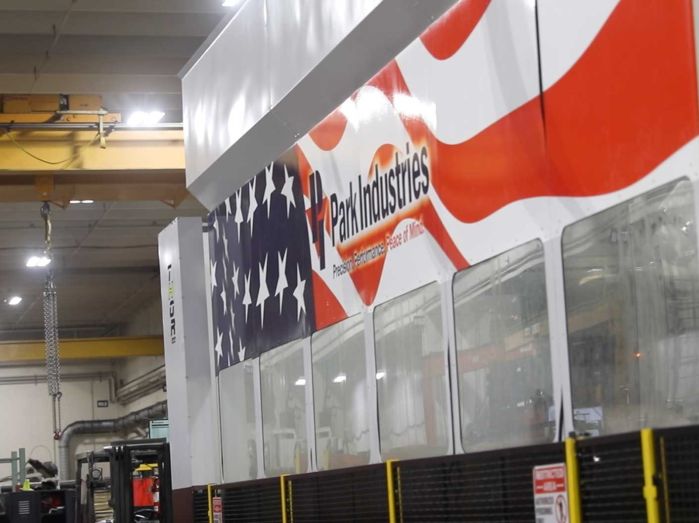
Since the mid-1800s, St. Cloud has been an epicenter for granite. With 20 different magma bodies, the granite found here is consistent in its patterns and has different color options, something that isn’t easy to find in one location.
Early on, St. Cloud granite was being used all over the world—no wonder, then, that some of the industries in the area were created in response to quarrying. In 1953, Leon and Alvina Schlough started Gran-A-Stone, to become Park Industries. In the 70+ years since, the family-owned company has grown to the point that they are North America’s largest stone fabrication and countertop equipment manufacturer.
And of the 320 associates who currently work at Park Industries, more than half are SCTCC graduates.
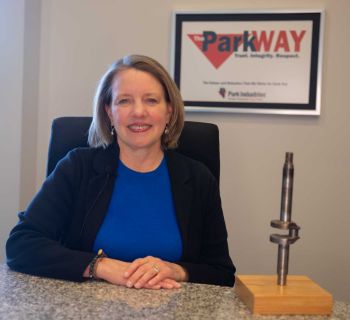
Joan Schatz, Chief Executive Officer for the past 19 years, is the first to say that growth and development are important, and the partnership that Park has with SCTCC is a testament to that.
“SCTCC is incredibly important to us as an employer in this region because something on the order of 60% of Park associates have a degree from the technical college,” noted Schatz. “Here at Park there’s all kinds of growth that’s available, and part of the partnership that we have with SCTCC is ongoing educational opportunities to grow those technical skills.”
The ParkWay
“One of my firm beliefs is that business is all about people.” Schatz emphasized this several times during conversation. “One thing that has always been really important at Park is our culture and making this the kind of environment people want to be a part of—the ParkWay.”
The focus on people is evident when you walk in the door at Park Industries. The people are smiling, happy to be there, and accommodating. Along one wall of the conference room we are in is a large sign that says ParkWay. The ParkWay is a philosophy that focuses “on a strong company culture that treats associates and customers the right way.” For associates, this means flexibility in the workplace and ensuring that their personal lives thrive alongside their work life.
Matt Lindbergh is a two-time SCTCC graduate who’s been working at Park for 25 years. He finished his Welding degree while a PSEO student, then came back to SCTCC for a Mechanical Design Engineering Technology degree.
“I’ve moved up the ranks and done a lot of different jobs at Park Industries,” Lindbergh shared. With his two-year degree from SCTCC, Lindbergh now works alongside others with further credentials. “I love that we make some extremely sophisticated machinery, not just little widgets. They’re very complicated and complex machines.”
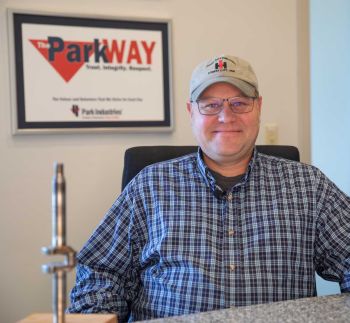
Currently a Mechanical Staff Engineer in the R&D department, Lindbergh is a part of new product design, usually a long process. He and his team recently worked on the Spartan machine, which took a year. The team engineers a product that differentiates Park from the competitors, they test it, and then they roll it out to the market.
“I absolutely love designing things. I like the creation portion of it, coming up with new ideas and implementing them, seeing them come alive on the shop floor,” he said.
Another thing Lindbergh likes? The people. “There’s not a corporate vibe. It’s a longstanding community.”
This is the ParkWay Culture in action, and you can see it spread into associates’ personal lives as well.
The Partnerships
The number of Park Industries’ donations, sponsorships, and other financial contributions to SCTCC can be counted off a spreadsheet. What is more important is the visibility that Park Industries’ associates have at SCTCC events.
Schatz has been a long-time member of the SCTCC Foundation Board, which guides the Foundation’s fundraising and scholarship support for students. She also stressed the importance of associates on advisory boards for different programs. Industry representatives on advisory boards are vital to ensure the curriculum for programs is current and prepares students for the workforce.
Lindbergh is on the advisory board for Mechanical Design and even taught a couple semesters when instructor Dave Johnson was out. (Note: he loves Park and has no plans to change careers.) He was even at SCTCC’s Open House to help promote the program to future students.
But the SCTCC connection he’s most involved in is VEX Robotics. Volunteering at VES has given Lindbergh a look into the future careers of kids on robotics teams: “You know, they’re building miniature versions of the machines that we build here.”
The Manufacturing
The machines that Park Industries builds are big. Like needing a semi-trailer to deliver them big.
The large manufacturing area, where Lindbergh’s hard work comes to life, is bright, clean, and automated, and there’s not an assembly line in sight.
“Manufacturing is far from the dark, dirty, dangerous job that people think it is,” Schatz remarked. “You have this great combination of technical manufacturing and producing almost artwork, in some ways, and with a level of complexity.”
Creating the machinery is very technical, challenging, and complex. Machines leave the floor in St. Cloud and are sent to various companies, including many small businesses, that create products to be distributed across the world. In fact, if you have a granite or other stone countertop in your home, it’s highly likely that it was shaped and fabricated on a Park Industries machine.
“People always need to have a place to live. If we look forward into the future, there is a housing shortage, so there are many opportunities in our industry; we’re very tied to housing,” Schatz shared when thinking about the future.
While Park Industries is primarily connected to housing, a significant part of the nation’s economy, the manufacturing industry in general is an even larger portion of the economy overall.
“[Manufacturing is] a strategic pillar for our nation and the economy. For every dollar invested, $2.69 of economic value is produced. That’s one of the highest returns of any industry in our economy,” Schatz explained.
If manufacturing is a pillar of the US economy, then the skilled people who work in it are the very foundation, including SCTCC graduates.
The Way Forward
It’s not a stretch to connect quarrying granite in the 1800s to an educational space where people learn skills to create machines that shape granite. SCTCC has always responded to the needs of the region’s industry, creating and cultivating partnerships that allow for innovation and progress.
But what SCTCC and Park Industries have the most in common is their focus on people. It’s a symbiotic nature between the community’s college and champions of the ParkWay—giving students education and training to do the work, then providing opportunities for future students to get that education. It turns out that the people dedicated to the work they do, whether it’s creating machines that will cut stone or creating futures for students, are the actual granite bedrock.
Sources:
https://www.mprnews.org/episode/2023/05/16/st-clouds-granite-reveals-the-history-of-minnesota
https://www.parkindustries.com/company/parkway-culture/