
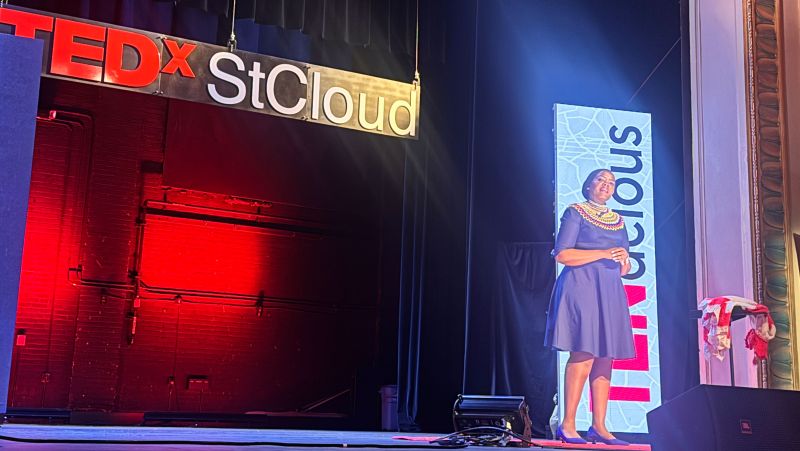
A couple of months ago, I sat in Njeri’s office feeling overwhelmed. I’m a first-generation college student, and nobody hands you a map for this. I didn’t know how to balance everything, and some days I wondered if I belonged here at all. Njeri, Director of the Multicultural Center, listened, and then she shared some of her own story. I walked out of that office lighter than when I walked in.
So when I sat down to listen to her TEDx talk, I expected a good speech about leadership. I didn’t expect to feel like I was sitting at her grandmother’s table. That’s what she does. She takes something simple, like a calabash, a shawl or a family story, and helps you see that a whole leadership lesson has been hiding inside it all along.
Lessons Learned: One
The first lesson that stayed with me was the calabash principle. She talked about her grandmother feeding her from a calabash, and how she thought she was just being fed breakfast, when really, she was being fed identity, dignity and belonging. The part that hit me hardest was when she said a perfect calabash can hold things, but a cracked one teaches us something different: our brokenness can be the opening that lets compassion through. As a student, I needed that. So many of us walk into college carrying cracks we try to hide. Njeri reminded me that those cracks can be exactly what helps me understand someone else’s struggle.
She also said something I wrote down right away: “A leader who gives once creates a moment. But a leader who keeps going back to the well becomes a source.” Anybody can show up when the crowd is loud. The real test is the second pour, and the tenth, long after anyone’s keeping score. She asked a question I’m still thinking about: Am I becoming lighter or heavier for the people around me?
Lessons Learned: Two
The second lesson was chevron leadership. She told us about a photo of her great-grandmother wearing a pink and white chevron shawl, and how each thread was strong but couldn’t make a pattern alone. Each thread pulls against the ones beside it, and that tension is what holds the shawl together. Then she said something I loved: sometimes what we call unity is really just uniformity, everyone thinking the same way. The person who challenges you might not be disrupting your pattern—they might be strengthening it. That made me think about my classmates, my coworkers, and the people I want to build community with. I don’t need everyone around me to think like me. I need people who see what I can’t.
Lessons Learned: Three
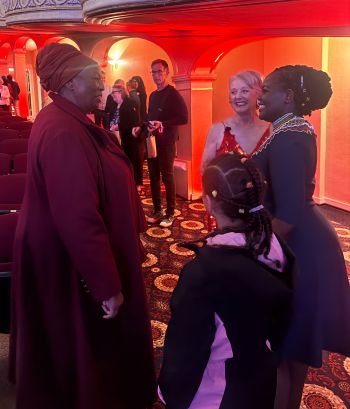
The last lesson was AI, but not the AI we usually talk about. Njeri called it ancestral intelligence. In a time when everyone’s talking about technology replacing everything, she reminded us that some things can’t be downloaded or copied: a grandmother’s story, a recipe passed down through generations, the feel of fabric woven by human hands. Before strategic plans, there were stories. Before the leadership seminars, there were grandmothers. That really moved me, because it means the wisdom we need isn’t always somewhere out there.
Sometimes it’s already in us, waiting to be remembered.
She closed by asking us to find our calabash, find our thread and find our pattern, and to ask ourselves what we’re weaving that will outlive us. Her final words gave me chills: one day someone will inherit the thread you’re carrying, and when they ask where that wisdom came from, may the answer be someone remembered, and that someone was you.
Starting Something from Lasting Lessons
The calabash lesson stayed with me most, because it’s the heart of something I’m building. I’m starting a club at SCTCC called Picked Perfect, a sisterhood for minority women on campus. The name means being chosen, and believing that your whole story, including the hard parts, is perfect as a map of where you’ve been. Hearing Njeri say that our cracks can become openings for compassion felt like confirmation. I’m not building Picked Perfect spite of my cracks I’m building it because of them.
When Njeri and I talked about the club, she told me to build it so it keeps going after I graduate. After hearing her talk, I finally understood why that mattered so much to her. The same woman who listened to me in her office was standing on that stage, asking a whole room to think about what we’ll leave behind for the people who come after us.
Njeri showed me that leadership isn’t something I have to wait until after graduation to step into. It’s how I show up, who I pour into, and what I choose to carry forward. I want to be the someone she talked about. She handed me a thread in her office that day. Picked Perfect is how I plan to keep weaving it, so the next first gen woman who feels like she doesn’t belong walks into a room full of sisters who already saved her a seat.
Shaqueila Hudson is a Marketing Sales Management student and a Marketing Assistant workstudy in the SCTCC Marketing & Communications Department.