
With strong demand, flexible training, and room to advance, manufacturing is opening new doors for the next generation of workers.
Urgently Hiring: Creative problem solver who enjoys critical thinking and hard work. Must enjoy continuously looking for improvements, working in a clean and safe environment, have a knack for technology and dislike for sitting still. The ideal candidate will be open to in-person communication, understand fundamental mathematical problems, and is proficient with basic hand tools.
Benefits: Flexible work schedule, paid education, health care, paid time off, parental leave… and so on.
Compensation: An average of $36.09/hour
With the programs available at St. Cloud Technical & Community College (SCTCC) and the job opportunities at Central Minnesota manufacturing facilities, there has never been a better time to explore a career in manufacturing.
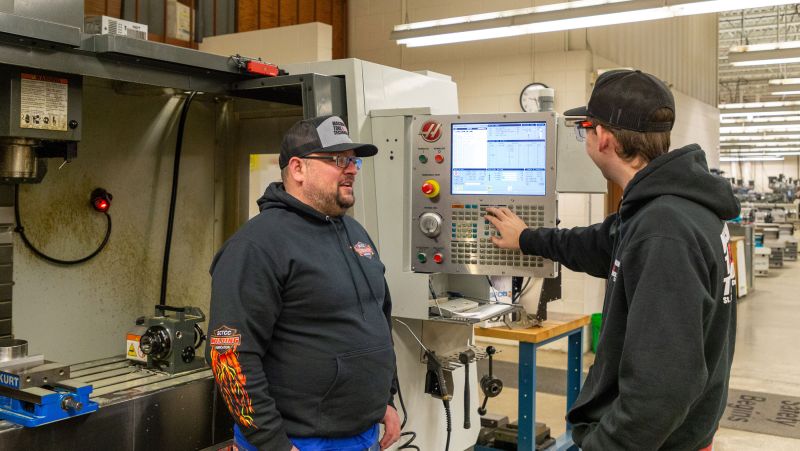
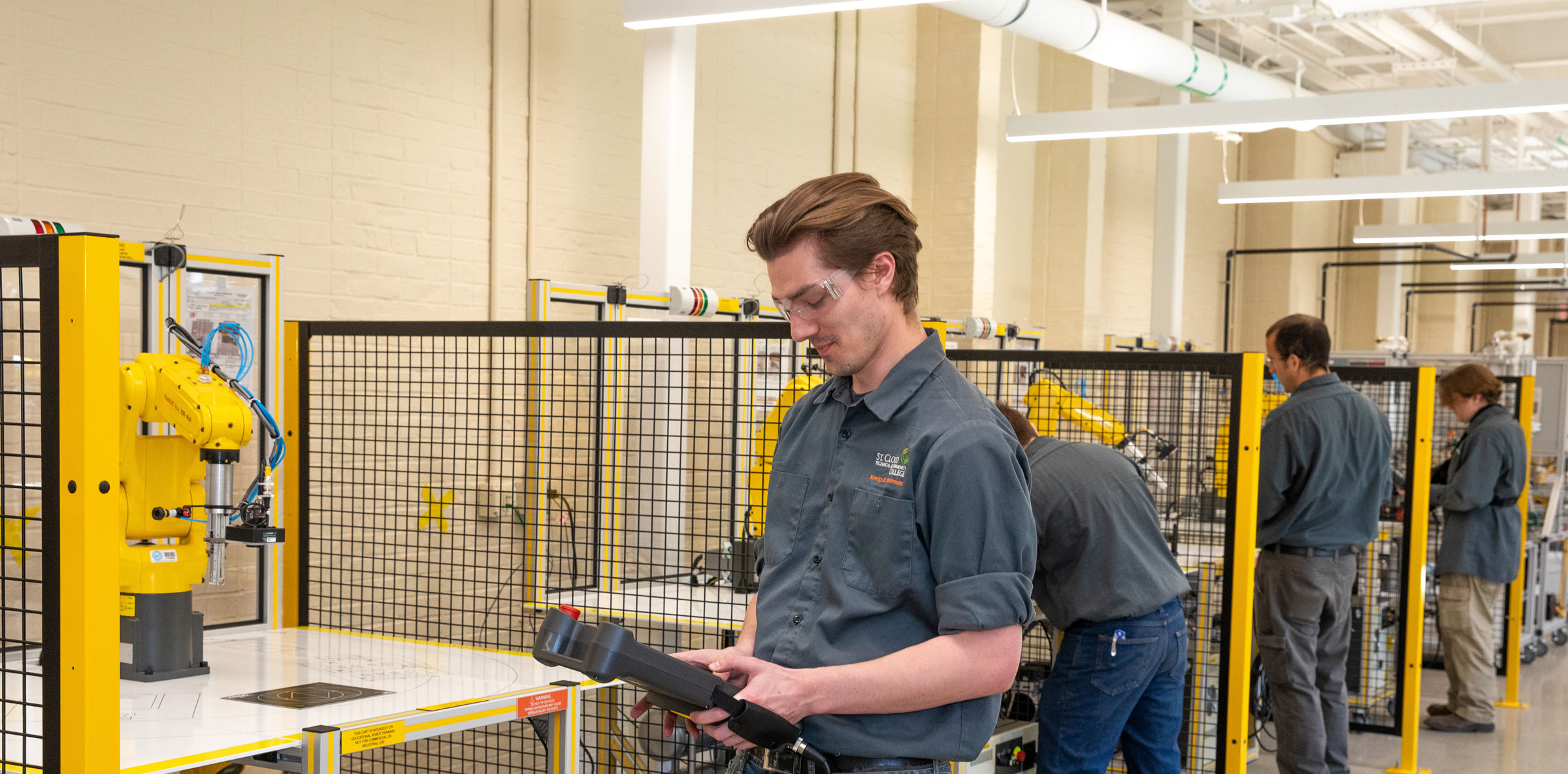
Steve Hoemberg is the Dean of Skilled Trades and Industry at SCTCC. “I think sometimes manufacturing gets a bad rap because the word itself leads people to believe that you’re just making widgets,” he said. The reality is much more complex. Often when we think of manufacturing, we think of dark and dirty workplaces, long and demanding hours, and monotonous or repetitious jobs. While those still exist to some extent, the state of manufacturing today more closely resembles a science laboratory – especially within the CNC and advanced machining and robotics and industrial controls realms.
CNC – or computer numerical control – and advanced machining are the act of shaping metal and other hard materials with precision. Unlike welding, which involves fusing metals together, machining is taking metal away to create a piece or part. Machinists use tools like lathes, mills, grinders, drill presses, computers and CNC machines to manufacture intricate, usable parts.
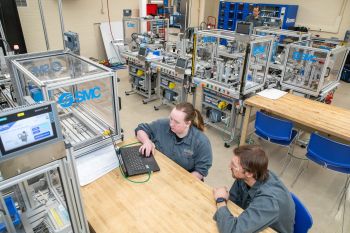
Aaron Barker is an instructor of Robotics & Industrial Controls (RICT) at SCTCC and has been with the college for 26 years. Within Robotics, there is a mechatronics degree and instrumentation & process control (I&C) degree.
To explain the I&C degree, Barker often asks people what soda they like to drink, and why – to which people answer that they like the taste. “If you go from Minnesota to California, you want it to taste the exact same, and that’s where the I&C tech comes into play,” Barker said. The I&C tech is responsible for calibration – or mixing the ingredients to exactly what it’s supposed to be within half a percent.
It’s not just beverages either. “Take a nuclear reactor for example,” Barker said. “We want that to stay at a certain temperature, otherwise there are serious consequences.” These technicians work at power plants, breweries, in oil fields, at beverage manufacturers – anything where there is a flow, temperature or process that needs to be monitored.
Mechatronics – formerly called industrial controls – is a combination of mechanical and electronics. “The best way to describe mechatronics is a jack of all trades,” Barker said. “They’re the ones who keep everything running inside a plant.” Mechatronics technicians know welding, machining, computer networking, some drafting and even HVAC and plumbing. “The specialty, though, is programmable logic controls (PLC) and electronics,” Barker said.
A mechatronics technician needs to be able to make process decisions in the middle of the night when the line goes down. They need to be able to answer a wide variety of questions, from “Can I machine a part to get the machine up and running?” to “Can I flip this valve and keep the air conditioning running until the HVAC technician comes in?”
That depth and breadth of knowledge is a huge selling point for the degree. “As someone who worked in mechatronics, I’ve never had to hire anyone to do anything in my house,” Barker said. It’s a degree that not only has great career paths but also gives students real-life skills that can benefit them outside of work.
That’s the case with many of the degrees in manufacturing at SCTCC. “Our people, when they’re learning to build things, they’re building themselves too,” Hoemberg said. “When you’re learning to repair stuff, you’re also giving yourself skills that last forever.”
The Manufacturing Mindset
Successful manufacturing students and employees are problem solvers. They’re builders – someone who likes to have a mental challenge and then likes to go do it. They aren’t afraid of technology, they love puzzles, and they don’t like to sit still.
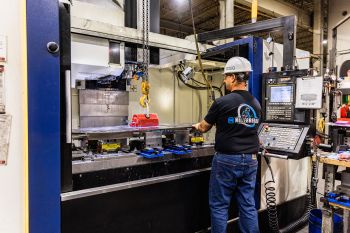
Millerbernd Manufacturing is a family-owned Minnesota manufacturer established in 1933, specializing in engineered steel structures for transportation and infrastructure, precision-formed metal products, pressure vessels, and custom weldments. “The strongest need is for people who combine technical ability with a safety first, problem-solving mindset,” said Ben Freese, reliability engineering and maintenance manager at Millerbernd. He says they look for candidates skilled in blueprint reading, welding, machining, industrial controls, robotics, mechanical troubleshooting, precision measurement, shop math, and computer skills.
“Just as important are dependability, communication skills, attention to detail, and a strong work ethic,” said Greg Carlson. Carlson is operations manager at Coldspring, a fourth-generation, family-owned company with more than 125 years of experience producing natural stone, bronze, and diamond tooling for memorialization, commercial construction, and public spaces nationwide. “We are looking for smart people with a positive attitude and genuine humility who treat others with respect,” he said.
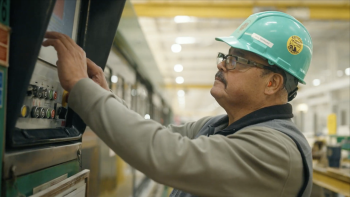
Many parents and even high school professionals simply may not realize that machining is a great career path for a talented math or science student. “Although stone and bronze are some of the world’s oldest building materials, producing these products is a modern manufacturing process,” Pat Soschnik, operations manager at Coldspring said. “Our teams combine advanced equipment, digital design files, CNC technology, automation, and precision measurement with the knowledge and craftsmanship required to work with a natural material.”
While math is an important skill in this field, technology is even more important. According to Freese, it’s part of everything they do. Millerbernd employees use advanced technology such as CNC equipment, robotics, automated systems, and digital tracking tools, combining hands-on craftsmanship with computer-based tools and data.
Data has become a major part of how technicians adjust and maintain processes and equipment. Supervisory control and data acquisition (SCADA) systems are installed into processes to monitor equipment and provide feedback on how it runs and how efficient it is. “We’re putting sensors in places we never thought of putting sensors before,” SCTCC’s Barker said. It’s all about continuous improvement and how to make things better, faster and more efficient. If that’s something a student enjoys, then they’ll do well in this industry.
A note on automation: it’s not taking skilled jobs away from qualified workers – it’s replacing the unfavorable tasks. Automation and robotics have improved safety, efficiency, and consistency while reducing many repetitive tasks, which frees up employees to spend time operating, programming, monitoring, and maintaining equipment than performing repetitive manual processes.
“Automation does not eliminate the need for skilled people; it changes the skills required,” Freese said. “We need employees who understand both the manufacturing process and the technology controlling it, including robotics, sensors, PLCs, drives, tooling, and data.”
Education on Your Terms
Stackable credentials in SCTCC’s CNC & Advanced Machining program, launched in 2024, are an appealing choice for many students who are concerned about cost, time commitment, and simply whether they’ll like the work. Within the machining career field, there are generally four types of jobs, and these come to life in stackable semesters, allowing students to do as little or as much schooling as they want.
In semester one, students earn their operator certificate. An operator is the person who physically operates the CNC machine. Semester two trains setup specialists who prepare the machine to be operated in addition to operating the machine. In the third semester, students earn their machining diploma, which involves everything from creating the plans to setup to operating. The fourth and final semester option culminates in the machinist engineering diploma. “These are people who look at a problem and say, ‘what would the solution be? How would we engineer it? What materials would we use?’” Hoemberg said.
All the certifications take two years to complete. After each semester is finished, students can choose to continue, or they can enter the workforce knowing jobs are plentiful with the credentials they’ve earned. The certifications have been designed to match the job market with the understanding that there are more operator job openings at any given time than engineering. Plus, each of these certifications is offered every semester to accommodate non-traditional students or people who are already working in the industry and want to further their education.
Flexibility is also built into the Robotics program. All lectures are recorded and available online each week, and students can complete online coursework whenever it works for their schedule. Students then schedule time for lab work as their schedules allow during the week to complete their assignments. Some students come in from 8 a.m. to noon three days a week. Others for two full days. “Students with jobs work with their current employer to figure out what days would be best for them to go to school,” Hoemberg said. “The concept is hybrid learning with flexibility in the schedule.”
Not only can students learn at their own pace, they can also add on more credentials as they desire. Many classes in the two Robotics degrees overlap, with only about 25 percent that are completely separate. “Most of our students double-major: they’ll do two majors in two years, which makes them that much more marketable for jobs,” Barker said.
Room to Grow
The demand in the robotics and industrial controls field is vastly unmet. “We cannot offer enough graduates fast enough,” Barker said. Many SCTCC students will get job offers while they’re still in school. “Employers will work around their schedule and get them in the field right away.”
Average wages for an instrumentation technician are more than $67,000 annually, with expected job demand growth of 19 percent by 2032, according to the Minnesota Department of Employment and Economic Development (DEED). SCTCC is home to the only Instrumentation & Process Control degree in the state of Minnesota. “We get other states calling us because they know we have this program and they can’t find people anymore,” Barker noted.
Looking locally, machinist is the 34th most in-demand job in Central Minnesota, with a projected 10-year growth rate of nearly 13 percent and over 2,290 openings over the next decade, according to data from DEED. With the flexible, stackable options at SCTCC, there are many opportunities for people to start as an operator and advance to CNC engineer.
There is also great opportunity for advancement within manufacturing once in the field. Millerbernd’s Freese often sees employees beginning as an operator or material handler and moving into roles such as maintenance technician, team lead, quality inspector or engineering support. “Cross training, internal job opportunities, mentoring, technical coursework, and tuition reimbursement can help employees build these skills,” he said.
According to Freese, manufacturing careers deserve to be viewed as first-choice careers, not backup plans. “The best way for students, parents, and educators to understand these opportunities is to engage with local manufacturers through tours, job shadowing, internships, co-ops, and advisory partnerships,” he said. “For students who enjoy hands-on learning and want to enter the workforce sooner, a technical-college pathway can be an excellent investment and can still support continued education later.”
To parents or students who feel that they must attend a four-year school to get a good job, Barker has one message: start at SCTCC. “Do a two-year degree, get the fundamentals, and then you can transfer on for the other two years and get an engineering degree,” Barker said. “Students save a lot of money by coming here, they go get a job, and then sometimes that employer will pay them to go back to engineering school for two years.”
Jordan Massmann, engineering and environmental manager at Coldspring, encourages students and parents to tour a manufacturing facility or even the labs at SCTCC to learn more. “Manufacturing today is about much more than making products. It is about innovation, technology, problem-solving and continuous learning,” he said. “Programs like SCTCC’s CNC and Advanced Machining and Robotics & Industrial Controls help prepare students for exciting careers that are critical to the future of manufacturing.”
Emily Bertram is the Director of Marketing and Communications at the St. Cloud Area Chamber of Commerce, where she helps connect businesses with resources, opportunities and initiatives that support regional growth. The Chamber supports workforce development across all career levels and industries, serving as a resource for employers seeking to attract, develop and retain talent. Through partnerships with educational institutions like St. Cloud Technical & Community College, the Chamber works to strengthen the local workforce and support career pathways that benefit both individuals and employers.